Quick Answer
To invest in the share market, open a demat and trading account with a SEBI-registered broker, finish KYC online with your PAN and Aadhaar, link your bank account, add money and place a buy order on NSE or BSE. The shares reach your demat account on the next trading day (T+1). If you don’t know which company to pick yet, a Nifty 50 index fund or ETF is the simplest first buy.
If you have searched “how can I invest in share market”, you have probably seen the same three steps everywhere: open a demat account, complete KYC, start investing. That part really is quick. The confusion starts after it. The buy screen asks you to pick Delivery or Intraday. A “zero brokerage” trade still shows charges on the contract note. Someone in a Telegram group promises 5% a month.
At Investor Weekly News, we built this share market guide for beginners around that second part. Every rate below comes from SEBI, the exchanges, the 2026-27 tax rules or a broker’s published rate card, and the worked examples use real numbers you can check yourself.
What do you need before you invest in the share market?
You need five things: a PAN linked to Aadhaar, a mobile number linked to Aadhaar, a savings account in your own name, a photo of your signature, and money you won’t need for a few years.
- PAN linked with Aadhaar. An unlinked PAN is treated as inoperative, and KYC agencies put your KYC status on hold until you fix it (HDFC Mutual Fund). Check your status on the Income Tax e-filing portal first. It takes two minutes.
- Aadhaar-linked mobile number. e-KYC and e-sign both run on an OTP sent to this number.
- A savings account in your name. The name should match your PAN exactly. “Rahul Kumar Sharma” on PAN and “Rahul K Sharma” at the bank is enough to get an application sent back. Our banking section covers account choices.
- A clear signature photo and a phone camera for the live selfie or video check.
- An emergency fund, kept separate. Shares can fall right when you need cash. Park a few months of expenses in a savings account or FD before you buy your first share.
Should you start with shares, an ETF or a mutual fund?
If you can’t yet read a company’s quarterly results, start with an index fund or ETF. Move to individual shares once you can explain, in two lines, why you own each one.
| Route | What you own | Suits you if | Needs a demat? | Watch for |
| Individual shares | Part of one company | You will follow its results every quarter | Yes | One company’s bad year hits you fully |
| Index ETF (for example, a Nifty 50 ETF) | A basket that tracks an index, traded like a share | You want the whole market in one buy | Yes | Pick ETFs with good daily trading volume |
| Index or equity mutual fund (SIP) | Units of a pooled fund, bought monthly | You want a fixed amount invested automatically | No | Expense ratio and exit load |
SEBI’s investor site describes mutual funds as offering diversification and professional management, and ETFs as adding liquidity at often lower cost than traditional mutual funds (SEBI). Our mutual funds and ETFs section goes deeper on picking between them.
[Image 1: route comparison]
How do you open a demat and trading account?
You open both in one online form with a SEBI-registered broker. The trading account places your orders on the exchange; the demat account holds the shares you buy.
- Pick a SEBI-registered broker and confirm it on SEBI Check (covered in the scams section below).
- Fill in the form with your PAN, Aadhaar, bank details and income range.
- Complete e-KYC. Verify Aadhaar by OTP, upload your signature and record a short selfie video.
- Choose a nominee. Single holders either add a nominee or formally opt out. SEBI has been reviewing how many nominees an account can carry in 2026, so follow what your broker’s form allows (Upstox).
- Decide on the DDPI. The Demat Debit and Pledge Instruction replaced the old power of attorney for moving shares out of your demat after a sale and for pledging them (The Week). Skip it and you approve each sale yourself.
- e-sign the application and wait for your login details.
The usual reasons for rejection: an inoperative PAN, a name mismatch between PAN and bank, or a blurry signature.
How do you place your first order?
Choose Delivery, use a limit order close to the current price, enter the number of shares, and place it between 9:15 am and 3:30 pm on a weekday. Those four choices are how to buy shares online on any broker app.
Delivery or Intraday? Delivery (also called CNC or Longterm) means you keep the shares. Intraday (MIS) means you promise to close the trade the same day. Forget, and the broker closes it before the market shuts, sometimes for a fee. Zerodha, for example, charges ₹50 per order for auto square-off orders (Zerodha).
Market or Limit? A market order fills at once at the best available price. A limit order fills only at your price or better (Chola Securities). Say a share trades at ₹1,000 and you set a limit of ₹1,002. You will never pay more than ₹1,002 a share, even if the price jumps in the second after you tap Buy.
When does it show up? India settles equity trades on T+1. Buy on Monday and the shares reach your demat on Tuesday; sell on Monday and the money reaches your trading account on Tuesday (m.Stock). Weekends and exchange holidays don’t count. The regular session runs 9:15 am to 3:30 pm, Monday to Friday (Upstox).
After every trade, open the contract note your broker emails. SEBI asks investors to get one within 24 hours of each trade and keep it (SEBI). New listings work the same way once they start trading; our upcoming IPOs page tracks them.
[Image 2: first order and T+1 timeline]
How much does one share market trade really cost?
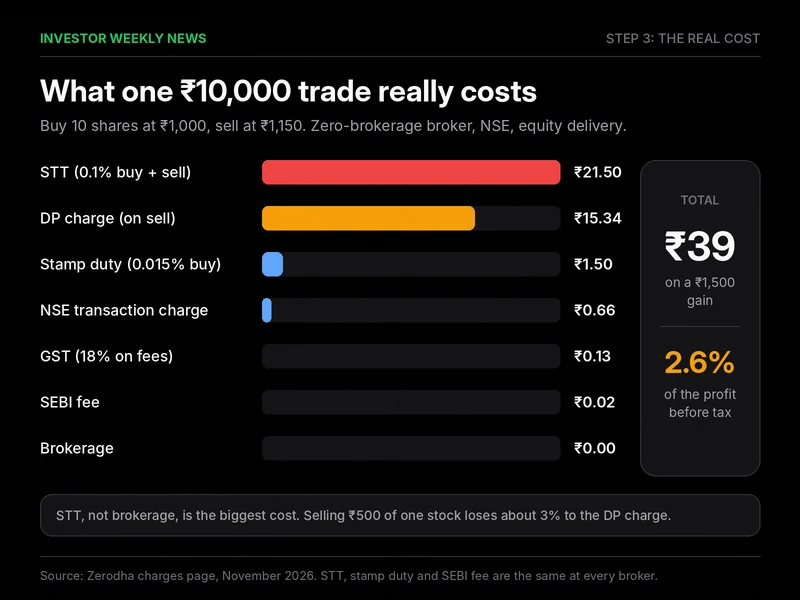
About ₹39 on a ₹10,000 buy that you later sell for ₹11,500, even at a broker that charges zero delivery brokerage. Here is where that money goes.
| Charge | Rate (equity delivery) | On the buy (₹) | On the sell (₹) |
| Brokerage | ₹0 at this broker | 0.00 | 0.00 |
| Securities Transaction Tax (STT) | 0.1% on buy and sell | 10.00 | 11.50 |
| NSE transaction charge | 0.00307% | 0.31 | 0.35 |
| SEBI fee | ₹10 per crore | 0.01 | 0.01 |
| Stamp duty | 0.015%, buy side only | 1.50 | 0.00 |
| GST | 18% on brokerage + exchange + SEBI fees | 0.06 | 0.07 |
| DP charge | ₹15.34 per stock, per day you sell | 0.00 | 15.34 |
| Total | 11.87 | 27.27 |
Rates from Zerodha’s charges page in November 2026. STT, stamp duty and the SEBI fee are the same at every broker; brokerage and the DP charge vary.
Two things stand out. STT, not brokerage, is the biggest cost on a delivery trade. And the flat DP charge punishes small sales: sell ₹500 worth of one stock and ₹15.34 is about 3% gone before tax.
[Image 3: cost breakdown of a ₹10,000 trade]
How is share market profit taxed in India?
Capital gains tax on shares depends on how long you held them. Profit on shares sold within 12 months is taxed at 20%. Hold for more than 12 months and you pay 12.5% only on gains above ₹1.25 lakh in a financial year. Dividends are added to your income and taxed at your slab rate. Budget 2026 kept these rates unchanged for 2026-27 (Business Standard; Bajaj Finserv).
| Income | When it applies | Tax |
| Short-term capital gain | Sold within 12 months | 20% |
| Long-term capital gain | Held for more than 12 months | 12.5% above ₹1.25 lakh a year; the first ₹1.25 lakh is tax-free |
| Dividends | When a company pays you | Your slab rate; 10% TDS once one company pays you more than ₹10,000 in a year (ClearTax) |
A 4% health and education cess is added on top.
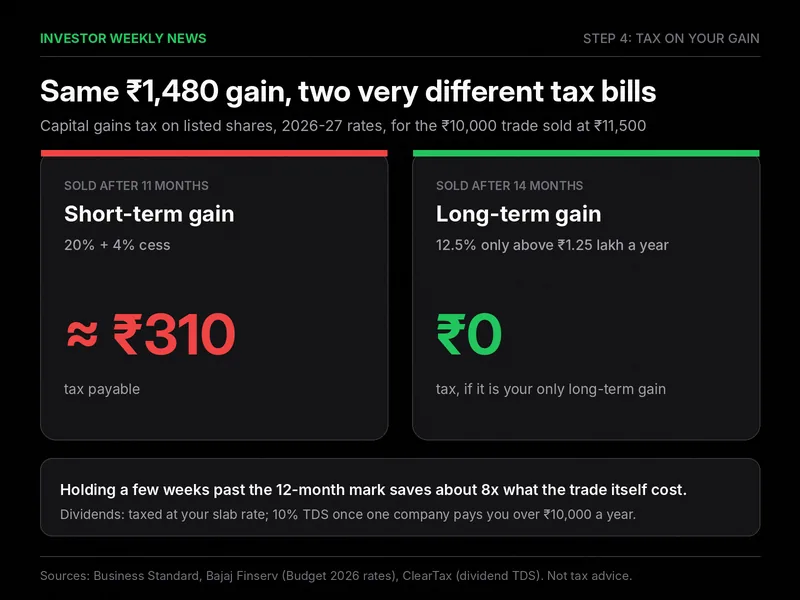
Now run the same trade through it. Sell after 14 months and the gain of about ₹1,480 sits inside the ₹1.25 lakh exemption, so you pay nothing if it is your only long-term gain that year. Sell after 11 months and it is short-term: roughly ₹310 at 20% plus cess. Holding a few weeks past the 12-month mark saves about eight times what the trade itself cost. Your final bill depends on your total income, so ask a tax professional if you are unsure. Our personal finance guides cover tax filing in more detail.
[Image 4: short-term vs long-term tax on the same trade]
How can I invest in share market with little money?
There is no official minimum. You need the price of one share or one ETF unit, plus charges. Because the DP charge is flat, investing a few thousand rupees at a time works out cheaper than a few hundred every week.
If your budget is ₹500 to ₹2,000 a month, a direct mutual fund SIP is the cleaner route. Some brokers, Zerodha among them, charge no commission and no DP charge on direct mutual funds (Zerodha).
A realistic first 90 days:
- Weeks 1 and 2: Open the account, check the broker on SEBI Check, add a nominee, and switch on only the equity segment.
- Weeks 3 and 4: Make one small purchase, such as a Nifty 50 ETF. Read the contract note and find the units in your holdings.
- Month 2: Pick one date every month and invest the same amount, either in the ETF or through an index fund SIP.
- Month 3: Choose one company whose products you use. Read its latest annual report and its last four quarterly results before you buy. Write down why you own it, so you know what would make you sell.
Should beginners trade F&O?
No. SEBI’s study of the equity derivatives segment for FY26 (April 2025 to March 2026), released on 20 August 2026, found:
- 87.7% of individual traders ended the year with a net loss.
- Individuals lost ₹91,685 crore in total, and options caused 92% of those losses.
- Traders who lost money lost ₹1.47 lakh on average; those who made money gained ₹1.22 lakh on average.
Source: Business Today on the SEBI study. Buying shares, ETFs or funds for delivery is a different activity. If you enjoy following markets, read our stock market news instead of trading options on it.
How do you avoid share market scams?
Verify the entity on SEBI Check, pay only to an “@valid” UPI ID, and ignore anyone who sells tips or promises fixed returns.
- SEBI Check. Enter a broker’s name, registration number or UPI ID on the SEBI Check portal or app. It shows whether the entity is registered and in which category, such as broker, mutual fund or investment adviser (ICICI Direct).
- @valid UPI IDs. SEBI-registered brokers and mutual funds collect money through UPI IDs that end in “@valid”, such as abc.brk@validicici for a broker or xyz.mf@validicici for a fund. Look for a thumbs-up inside a green triangle on the payment screen. A request to pay a personal UPI ID is a red flag.
- Tips and promises. SEBI tells investors not to act on hot tips or rumours, not to deal with unregistered intermediaries, never to share their account password and never to borrow to invest (SEBI).
If something goes wrong, email your broker’s grievance desk first. Still stuck? File on SEBI’s SCORES portal, where the entity must reply within 21 calendar days, with two further levels of review (SEBI SCORES). The SMART ODR portal handles online conciliation and arbitration (NSE).
[Image 5: three safety checks]
How do you choose a stockbroker?
Pick the one with clear charges and no pressure to trade more. Check these before you sign up:
- Registration on SEBI Check as a stockbroker and depository participant.
- Delivery brokerage: zero at some brokers, per order or a percentage at others. Read the pricing page, not the ad.
- DP charge and yearly maintenance (AMC): ask about a Basic Services Demat Account (BSDA). At Zerodha, a BSDA with holdings up to ₹4 lakh pays no AMC from the second year (Zerodha).
- Hidden extras: call-and-trade fees, auto square-off fees, physical contract notes.
- Support you can reach on the day an order goes wrong.
- Defaults: keep F&O and margin trading switched off until you have a reason to use them.
FAQs
Can I invest in the share market without a demat account?
Not for shares or ETFs. Mutual funds are the exception: you can buy them from the fund house or a platform and hold units in a Statement of Account (HDFC Mutual Fund).
What is the minimum amount to start?
The price of one share or ETF unit, plus charges.
Can students or minors invest?
Anyone 18 or older with a PAN and bank account can open their own account. Under 18, a parent or guardian opens and runs a minor account; some brokers, Zerodha among them, open these free (Zerodha).
Is investing in shares safe?
The system is regulated by SEBI and your shares sit in your own demat account. The returns are not guaranteed: prices move with company results and the economy and can fall below what you paid (SEBI).
How we researched this guide
The Investor Weekly News Team checked every rate and rule in this guide against SEBI’s investor website, NSE, Budget 2026 coverage of the 2026-27 tax rates and a broker’s published rate card, all in November 2026. Spotted a rate that has changed? Tell us and we will correct it.
Want one plain-English market update a week instead of tips from strangers? Subscribe free to Investor Weekly News.
This guide is for education only and is not investment advice.