
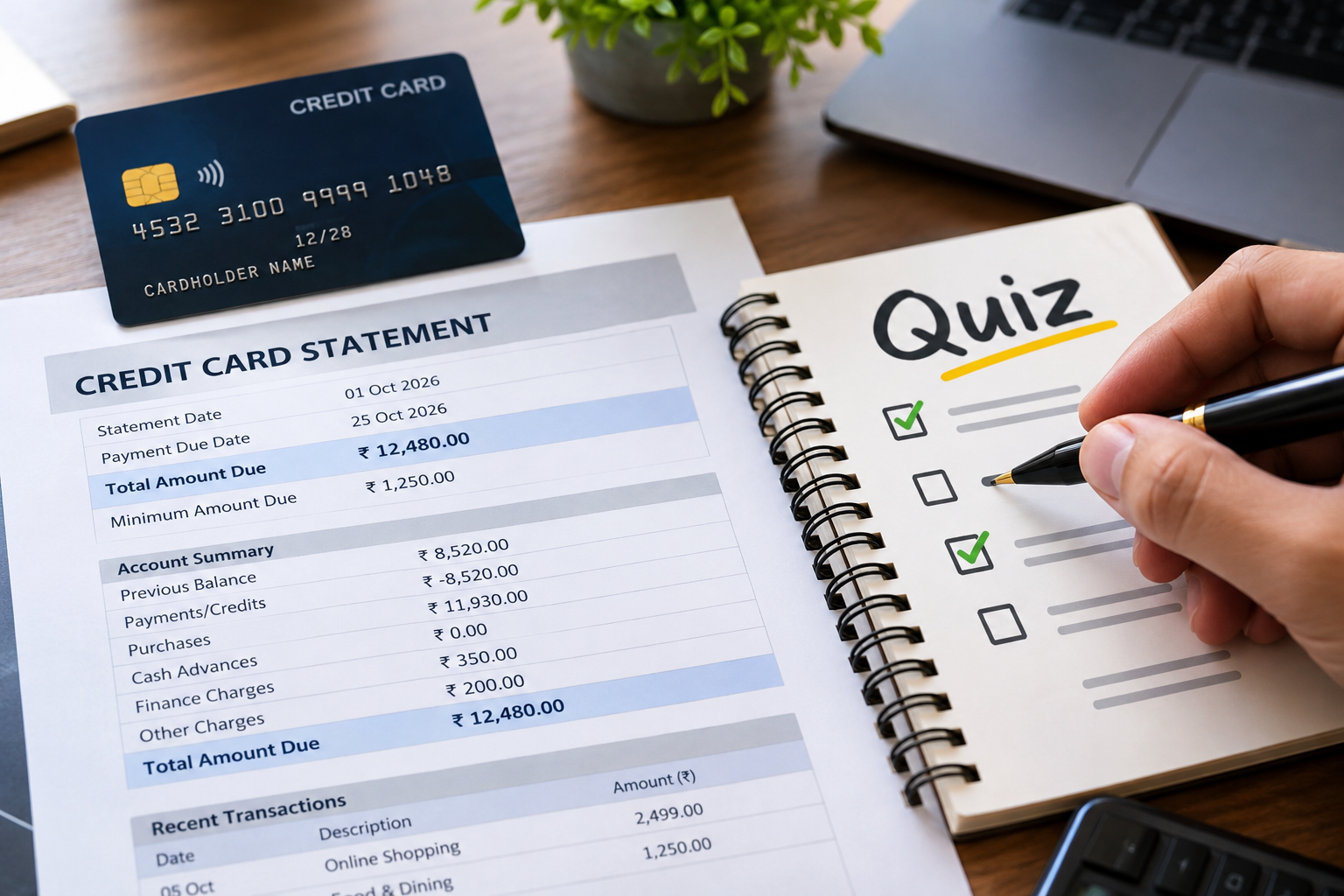
Quick Answer: A credit card bill quiz checks whether you can read your statement and dodge avoidable charges. The key rule is simple: paying the total amount due by the due date keeps your purchases interest-free, while paying only the minimum can cost roughly 2.5% to 3.75% a month in interest. Take the 15 questions below, then use the score guide to see where you stand.
Most of us glance at the minimum due, tap pay, and move on. This credit card bill quiz shows what that habit can cost in rupees and tests whether you can read every line of your statement with confidence. It has 15 questions across three levels, each with an answer and a reason, so you know exactly what to do before your next due date.
In short:
- The quiz has three levels: statement basics, payments and interest, and real-life scenarios.
- It takes about five minutes, and every answer comes with a reason and a next step.
- Your final score maps to a short action plan.
Who Should Take This Quiz?
If you have ever paid the minimum due because it felt safer, this is for you. It also suits first-time cardholders, students holding an add-on or secured card, salaried professionals juggling two or three cards, and anyone who has been surprised by a line they could not explain.
A credit card bill, also called a statement, is a monthly summary of what you spent, what you owe, when you must pay, and what you will be charged if you do not. Interest, late fees and GST on fees are the lines that surprise people most, so the questions below focus on them.
Is the Amazon Credit Card Bill Quiz Still Running?
Many people searching for this phrase want the Amazon contest, not a study quiz. In 2020 and early 2021, Amazon India ran in-app quizzes with five questions on credit cards, CIBIL and paying bills through Amazon Pay. One edition offered ₹50 in Amazon Pay balance to five lakh winners, and another promised to pay a winner’s bill up to a cap.
At the time of writing, in October 2026, I could not find a live edition. Answer pages from earlier rounds are outdated, so do not rely on them. If Amazon runs a new round, it will appear inside the Amazon app, so check there.
One safety rule matters more than any prize: no genuine quiz needs your card PIN, CVV or OTP. Links shared on WhatsApp or Telegram that promise free bill payment are a common route for phishing, so never enter card details on them. If you want the learning without the risk, take the quiz below.
Take the Credit Card Bill Quiz (15 Questions)
Grab a pen and note your answers, then check them in the next section. Rupee figures are illustrative, so your own card’s numbers will differ.
Level 1: Statement basics
Q1. Which date decides whether you pay a late fee? A) Statement date B) Payment due date C) Purchase date D) Card expiry date
Q2. What does “Total Amount Due” mean? A) The minimum you must pay B) Your credit limit C) The full amount payable on the statement, net of any credits D) Your reward balance in rupees
Q3. What does paying the “Minimum Amount Due” achieve? A) It keeps your account from being treated as overdue B) It clears your debt C) It stops all interest D) It raises your credit limit
Q4. Your limit is ₹1,00,000 and you have spent ₹35,000 this cycle, with nothing else outstanding. What is your available limit? A) ₹35,000 B) ₹1,00,000 C) ₹1,35,000 D) ₹65,000
Q5. What is a billing cycle? A) The period between the closing dates of two consecutive statements B) The days you get to pay late C) The validity of your card D) The time rewards take to credit
Level 2: Payments, interest and fees
Q6. Your total due is ₹40,000 and you pay only the ₹2,000 minimum. What happens to the interest-free period on your purchases? A) It continues unchanged B) It doubles C) It is suspended while the balance is outstanding D) It applies only to cash withdrawals
Q7. Which transaction has no interest-free period at all? A) Online shopping B) Cash withdrawal at an ATM C) Fuel D) A monthly subscription
Q8. A late payment fee on an Indian card usually carries what extra charge? A) No extra charge B) TDS C) Stamp duty D) 18% GST
Q9. Your total due is ₹40,000 and you pay ₹39,000 by the due date. What is the likely result? A) Interest can apply because the entire outstanding was not paid B) No interest, since you paid almost all of it C) The card is blocked D) Your rewards double
Q10. What does converting a bill into EMI usually do? A) Removes all charges B) Cancels the purchase C) Splits the amount into instalments with interest and often a processing fee D) Raises your limit permanently
Level 3: Real-life scenarios
Q11. Your due date falls on a Sunday. What is the safest move? A) Pay on Monday B) Wait for a reminder C) Pay double next month D) Pay two or three days before the due date
Q12. You spot an unfamiliar ₹2,499 charge. What do you do first? A) Wait for the next statement B) Block the card in your app and call the issuer C) Pay it and forget about it D) Share an OTP with a caller who promises a refund
Q13. You paid by UPI, but the bill still shows as unpaid. What next? A) Pay again immediately B) Close the card C) Check the payment status, keep the UPI transaction ID, and contact the issuer if it has not posted D) Ignore it until next month
Q14. Your salary arrives on the 28th, but your due date is the 20th. What is the best fix? A) Ask your issuer to change the billing cycle B) Pay late every month C) Take a cash advance D) Close the card
Q15. Which habit helps your CIBIL score most? A) Paying only the minimum B) Closing your oldest card C) Spending the full limit every month D) Paying on time and keeping your balance low against your limit
Credit Card Bill Quiz Answers With Explanations
| Q | Answer | Why | What to do |
|---|---|---|---|
| 1 | B | Your payment is measured against the due date, not the statement date. | Set a reminder three days before it. |
| 2 | C | It is the full amount payable on the statement, net of credits. | Pay this to stay interest-free. |
| 3 | A | The minimum keeps the account from being treated as overdue. It does not clear the debt. | Use it as a safety net only. |
| 4 | D | ₹1,00,000 minus ₹35,000 leaves ₹65,000. | Check your available limit before big purchases. |
| 5 | A | A billing cycle runs between two consecutive statement closing dates. | Ask your issuer if you want a different cycle. |
| 6 | C | RBI’s rules say the interest-free period is suspended while a previous balance is outstanding. | Clear the whole balance to restart it. |
| 7 | B | Cash advances attract interest from day one, plus a fee. | Avoid ATM withdrawals on a credit card. |
| 8 | D | Fees such as the late payment fee carry 18% GST. | Add GST when you estimate the real cost. |
| 9 | A | The interest-free period depends on paying the entire outstanding amount. | Pay the full total, not “almost”. |
| 10 | C | EMI conversion splits the bill into instalments, with interest and usually a processing fee. | Compare its effective rate with card interest. |
| 11 | D | Posting rules near holidays differ by issuer, so paying early is the safe choice. | Pay two or three days ahead. |
| 12 | B | Quick reporting limits the damage and starts the dispute. | Block the card, call, and note the reference number. |
| 13 | C | UPI payments can post late, and the transaction ID is your proof. | Contact the issuer with the ID before the due date. |
| 14 | A | Cardholders get a one-time option to change the billing cycle under RBI’s rules. | Call the helpline and pick a date after payday. |
| 15 | D | Payment history and low utilisation matter most. | Pay on time and keep your balance well under the limit. |
How Is a Credit Card Bill Calculated?
Think of a statement as a one-month diary of your card. Here is a simple example for a card with a ₹1,00,000 limit.
| Line on the statement | Illustrative amount |
|---|---|
| Previous balance | ₹0 |
| New purchases | ₹40,000 |
| Payments received | ₹0 |
| Interest, fees and taxes | ₹0 |
| Total Amount Due | ₹40,000 |
| Minimum Amount Due | ₹2,000 |
| Available credit limit | ₹60,000 |
| Statement date | 5 October |
| Payment due date | 25 October |
Here is what the key lines mean:
- Statement date: the day your billing cycle closes and the bill is generated.
- Payment due date: the deadline that decides whether late charges apply. Issuers often give around 15 to 20 days between the two dates.
- Total Amount Due: the full amount payable for the cycle, net of any credits.
- Minimum Amount Due: the smallest payment that stops the account from being treated as overdue.
- Finance charges and fees: interest on any balance you carry, plus fees such as late payment or cash advance fees, with GST on the fees.
Your interest-free window also depends on when in the cycle you spend. Say your cycle runs from 6 September to 5 October and the due date is 25 October. A phone bought on 6 September gets 49 days before payment is due. The same phone bought on 5 October gets only 20. Both are interest-free if you pay the full amount on time, which is why many cardholders time big purchases for just after the statement date. On most cards the longest window runs to roughly 45 to 55 days, but your card’s terms decide.
If your due date lands before your salary does, ask your issuer to change the billing cycle. RBI’s rules give cardholders a one-time option to do this.
What Happens If You Pay Only the Minimum Amount Due?
Paying the minimum keeps your account from being treated as overdue. It does not stop interest. Under RBI’s rules, the interest-free credit period is suspended if any balance from the previous bill is unpaid, and issuers must explain what paying only the minimum means. RBI also requires minimum dues to be set so the balance does not keep growing even when you pay on time. Most issuers calculate the minimum as a small share of the balance, often around 5%, plus any interest, fees, taxes and EMIs.
Here is what that looks like on the ₹40,000 bill, at 3.5% a month, which sits inside the 2.5% to 3.75% range that cards commonly charge:
| What you pay | Left unpaid | Approximate interest next month | Interest-free period on new spends |
|---|---|---|---|
| ₹40,000 (full) | ₹0 | ₹0 | Kept |
| ₹20,000 (part) | ₹20,000 | About ₹700 | Lost until cleared |
| ₹2,000 (minimum) | ₹38,000 | About ₹1,330 | Lost until cleared |
Real bills usually run higher, because issuers often charge interest from the purchase date, not the statement date. At 3.5% a month, the yearly cost works out to about 42%.
Must Read: Metro Brands IPO GMP Today Price: From the ₹500 Issue to ₹838 in 2026
How Can You Pay Your Credit Card Bill in India?
| Method | Typical speed | What to watch |
|---|---|---|
| UPI (through your UPI app or the issuer’s app) | Often within minutes to a few hours | Keep the transaction ID and confirm the payment shows on your card account. |
| Issuer’s mobile app | Usually same day | Fewest steps, and it shows payment status clearly. |
| Net banking bill pay | Usually same day | Check you picked total due, minimum due or a custom amount correctly. |
| NEFT or IMPS from another bank | IMPS is quick, NEFT runs in batches | Do not leave it to the last day. |
| Auto-debit | On the due date | RBI’s rules ask issuers to offer full, minimum or fixed-amount options. Keep funds ready. |
| Cheque or branch payment | Slowest | Avoid it close to the due date. |
A simple routine works well: pay two or three days before the due date, and set auto-debit for at least the minimum due as a safety net. Then pay the full amount yourself.
What Are the Most Common Credit Card Bill Mistakes?
| Mistake | What it costs | Fix |
|---|---|---|
| Missing the due date | A late fee, commonly about ₹100 to ₹1,300 depending on your balance, plus 18% GST, and a possible hit to your credit score | Auto-debit, reminders, and a billing cycle that follows your salary |
| Paying only the minimum, month after month | Interest of roughly 30% to 45% a year | Pay the full amount, or as much as you can, then consider EMI |
| Taking a cash advance | A fee plus interest from day one | Avoid it |
| Ignoring small recurring charges | Forgotten subscriptions drain money | Scan every line each month |
| Using most of your limit | A higher utilisation ratio that can pull your score down | Keep spends well under the limit |
| Forgetting the annual fee | The fee plus GST | Check your card’s terms and ask about a waiver |
Here is how this plays out for a salaried user. Riya’s salary arrives on the 15th, but one of her cards has a due date on the 8th, so she routinely pays about a week late. With an illustrative late fee of ₹700 plus ₹126 GST, each slip costs ₹826, or roughly ₹9,900 a year. Moving that card’s billing cycle so the due date falls on the 25th would stop the problem at no cost.
How Does Your Credit Card Bill Affect Your CIBIL Score?
Two habits move your score the most: paying on time, and keeping your balance low against your limit. CIBIL scores run from 300 to 900. The 30% utilisation rule you often see is a credit bureau convention, not an RBI rule, but it is a sensible target. On a ₹1,00,000 limit, a statement balance near ₹30,000 looks healthier than one near ₹90,000.
Issuers now report to the bureaus more often than they used to, so a missed payment can show up sooner. Paying only the minimum avoids a late mark, but it does little for your utilisation.
What Should You Do If You Cannot Pay the Full Bill?
Start by paying as much as you can above the minimum, because every rupee cleared reduces next month’s interest. Then pick the best route:
- Call your issuer. Ask about a repayment plan before you miss a payment, not after.
- Convert the bill to EMI. Say you convert ₹40,000 into six instalments at an illustrative 15% a year. Each instalment is about ₹6,960 and the total interest is about ₹1,764. Compare that with roughly ₹1,330 of interest for just the first month of paying only the minimum. Check your issuer’s actual rate and processing fee first.
- Consider a personal loan only if its rate is clearly lower than your card’s, after counting the processing fee.
- Avoid cash advances and never pay one card using another.
How Do You Spot Errors or Fraud on Your Credit Card Bill?
- Read every line. Match each merchant to your SMS and app alerts.
- Look for duplicates, forgotten subscriptions and unexpected foreign currency charges.
- Act fast on anything unfamiliar. Block the card in your app and call the issuer at once. Quick reporting protects you.
- Raise a dispute through the app or in writing, and keep the reference number.
- Escalate if needed. If your bank does not resolve it, or does not reply within about 30 days, you can file a complaint with the RBI Integrated Ombudsman at cms.rbi.org.in.
Never share your OTP, CVV or PIN, even with someone who claims to be from your bank.
What Does Your Score Mean?
| Score | Level | Your next step |
|---|---|---|
| 0 to 5 | Bill beginner | Open your latest statement and find five things: statement date, due date, total due, minimum due and available limit. Turn on auto-debit for at least the minimum due. |
| 6 to 10 | Getting there | Check how much interest appeared on your last three statements. Switch to paying the total due every month. |
| 11 to 15 | Bill savvy | Keep paying in full and early. Review annual fees and keep your utilisation low. |
Retake the quiz in a month and see how far your score moves.
FAQs: Credit Card Bill Quiz
What is the difference between total amount due and minimum amount due?
Total amount due is the full amount you owe on the statement, net of credits. Minimum amount due is the smallest payment that keeps your account from being treated as overdue. Only paying the total amount due by the due date keeps your purchases interest-free.
How many days do I get to pay my credit card bill?
Usually around 15 to 20 days after the statement date. After a purchase, the interest-free window runs to roughly 45 to 55 days at the longest. The due date is printed on every statement.
Can I pay my credit card bill using UPI?
Yes. Most UPI apps and issuer apps have a credit card bill payment option. Keep the transaction ID and confirm the payment shows on your card account before the due date.
What happens if I miss my due date by one day?
You lose the interest-free credit period, so interest can apply to the unpaid amount. RBI’s rules say an account should be reported as past due, or charged late fees, only after it stays overdue for more than three days counted from the due date. Pay on time anyway, and read your card’s Most Important Terms and Conditions to see how your issuer applies this.
Does paying only the minimum due hurt my CIBIL score?
It avoids a late payment mark, but a large carried balance keeps your utilisation high, which can hold your score down. Pay in full when you can.
Is the Amazon quiz still running?
I could not find a live edition in October 2026. Check the Amazon app for current contests and ignore unofficial links.
How can I tell if my bill has a fraudulent charge?
Compare every line with your SMS and app alerts, look for unfamiliar merchants and duplicates, and block the card and call your issuer at once if something looks wrong.
How is the minimum amount due calculated?
Most issuers use a small share of your balance, often around 5%, plus all interest, fees, taxes and any EMIs due. Your statement shows the exact figure, and your card’s terms explain the formula.
Conclusion
A credit card bill gets easier once you know four things: which date you must beat, which number to pay, what interest costs when you do not, and who to call when something looks wrong. Pay the total amount due, pay a few days early, and read your statement once a month.
Disclaimer
This article is for general education and is not financial advice. Fees, interest rates, billing cycles and rules differ by issuer and change over time. Rupee figures in examples are illustrative. Check your card’s Most Important Terms and Conditions, your latest statement and the Reserve Bank of India’s current guidelines before making decisions.
Leave a Reply