
To identify the correct statement from the following, judge each statement as true or false on its own, then choose the option that matches your verdicts exactly. In combination questions (“i and ii only”), a single statement you know is false removes every option that contains it, so you rarely need to test them all. This guide gives a five-step method, original worked examples in chemistry, physics and biology, and the wording traps that cost students marks.
It is written for students in Classes 9–12 and for anyone preparing for exams such as JEE, NEET or state entrance tests. Reviewed by: [add reviewer name and subject credential].
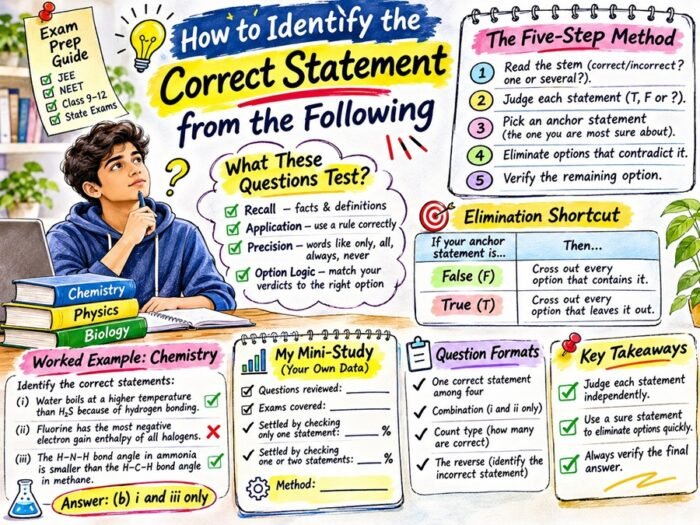
The method in 30 seconds
- Read the stem: does it ask for correct or incorrect statements, and for one answer or several?
- Judge each statement true or false before you look at the options.
- Start with the statement you are surest about.
- Cross out every option that contradicts it.
- Confirm the option left standing against any statement you skipped.
What these questions actually test
They test your knowledge and your reading precision at the same time. Many students who know the chapter still lose marks, because one statement is only half true or one small word changes its meaning.
| Skill tested | What the question checks | Where marks are usually lost |
|---|---|---|
| Recall | A fact, definition or value | Mixing up look-alike facts, such as Latin and English names of elements |
| Application | A rule applied to a situation | Using the rule in the wrong direction, such as the sign of work done |
| Precision | Qualifiers like “only”, “all”, “always”, “never” | Accepting a statement that holds in most cases but not in all |
| Option logic | Matching your verdicts to a combination option | Choosing an option that carries one extra false statement |
The same stem appears in several formats: one correct statement among four, a combination of numbered statements, a count (“how many are correct”), and the reverse (“identify the incorrect statement”). The variants section below covers each one.
The five-step method, with the elimination shortcut
The shortcut works because combination options overlap. If two options share a statement, deciding that one statement can settle several options at once.
- Read the stem twice. Note whether it asks for correct or incorrect statements, and whether one answer or several are expected.
- Judge each statement alone. Write T, F or ? beside it before looking at the options. This stops the options from steering your thinking.
- Pick an anchor statement. Choose the statement you are most sure about, ideally one that appears in many options.
- Eliminate with the anchor. Use the rule in the table below.
- Verify the survivor. Check the remaining option against every statement you skipped. If two options remain, test the one statement that separates them.
| If your anchor statement is… | Then… |
|---|---|
| False | Cross out every option that contains it |
| True | Cross out every option that leaves it out |
Example of the shortcut. Suppose the options are (1) i, ii only (2) i, iii only (3) ii, iii only (4) i, ii, iii. Statement (iii) appears in three of the four options. If you know (iii) is false, options 2, 3 and 4 all go, and option 1 is the answer without checking (i) or (ii) in detail.
When not to use the shortcut. Elimination multiplies the cost of a wrong anchor, because one mistaken verdict removes the right answer. Use it only when you are certain of the anchor, and always verify the survivor. If the question asks for the incorrect statement, flip your target first, so you are hunting for the false one.
Worked example 1: chemistry
Identify the correct statements from the following.
- (i) Water boils at a higher temperature than hydrogen sulphide because of hydrogen bonding in water.
- (ii) Fluorine has the most negative electron gain enthalpy of all the halogens.
- (iii) The H–N–H bond angle in ammonia is smaller than the H–C–H bond angle in methane.
Options: (a) i and ii only (b) i and iii only (c) ii and iii only (d) i, ii and iii.
Answer: (b) i and iii only.
| Statement | Verdict | Reason |
|---|---|---|
| (i) | Correct | Water molecules form hydrogen bonds with each other, so water boils near 100 °C while H₂S, which does not, boils far lower, near −60 °C. |
| (ii) | Incorrect | Chlorine, not fluorine, has the most negative electron gain enthalpy (about −349 kJ/mol against about −328 kJ/mol for fluorine). Fluorine’s small 2p subshell makes an extra electron repel the ones already there. |
| (iii) | Correct | The lone pair on nitrogen repels the bonding pairs more strongly, giving about 107° in NH₃ against 109.5° in CH₄. |
The shortcut. Statement (ii) is the surprising one, and it is false. It appears in options (a), (c) and (d), so all three go, leaving (b). You verify (i) and (iii) only as a final check.
Why students slip here. The statement sounds right because fluorine is the most electronegative element. Electronegativity and electron gain enthalpy are different quantities, and the trend does not match.
Worked example 2: physics (work done)
A person pushes a block up a rough inclined plane at constant speed. Identify the correct statements.
- (i) The work done by gravity on the block is negative.
- (ii) The work done by friction on the block is negative.
- (iii) The net work done on the block is zero.
- (iv) The work done by the normal force on the block is positive.
Options: (a) i and ii only (b) i, ii and iii only (c) ii, iii and iv only (d) i, ii, iii and iv.
Answer: (b) i, ii and iii only.
| Statement | Verdict | Reason |
|---|---|---|
| (i) | Correct | Gravity pulls down while the block moves up the slope, so the angle between force and displacement exceeds 90° and the work is negative. |
| (ii) | Correct | Kinetic friction acts down the slope, opposite to the motion, so its work is negative. |
| (iii) | Correct | Constant speed means no change in kinetic energy, so by the work-energy theorem the net work is zero. |
| (iv) | Incorrect | The normal force is perpendicular to the displacement, so it does no work. |
The shortcut. Statement (iv) is false because the normal force is perpendicular to the motion. It appears in options (c) and (d), so both go. Only (a) and (b) remain, and (iii) separates them: constant speed gives zero net work, so (iii) is true and (b) is the answer.
The idea behind the question. The sign of work depends on the angle between one force and the displacement. Net work depends on the change in kinetic energy. Gravity and friction both do negative work here, the person does positive work, and the total is zero. Students who treat “constant speed” as “no work” mix up these two ideas.
Worked example 3: biology, plus a look-alike facts check for Classes 6–10
Identify the correct statements from the following.
- (A) Chloroplasts contain chlorophyll and are found in plant cells.
- (B) Ribosomes are surrounded by a double membrane.
- (C) The nucleus controls the activities of the cell.
- (D) Mitochondria are called the powerhouses of the cell.
Options: (1) A, B and C (2) A, C and D (3) B and D only (4) A, B, C and D.
Answer: (2) A, C and D.
Statement B is false: ribosomes are not enclosed by any membrane. B appears in options (1), (3) and (4), so all three are eliminated at once. The other statements are standard textbook facts, so a quick check of A, C and D confirms option (2).
Look-alike facts that trip up beginners. Foundation-level statement questions often hinge on names and formulas that sound similar. Check these before trusting a statement:
| Topic | Correct fact | Common wrong version |
|---|---|---|
| Symbols of elements | Symbols come from Latin names: Na (natrium), K (kalium), Fe (ferrum), Cu (cuprum), Sn (stannum), Pb (plumbum) | “Stannum is the German name of tin” (stannum is Latin; the German word is Zinn) |
| Copper vs cobalt | Copper is Cu, cobalt is Co | Writing copper as Co |
| Blue vitriol | Copper sulphate pentahydrate, CuSO₄·5H₂O | CuSO₄·6H₂O |
| Silicon | A solid metalloid at room temperature | Calling it a liquid |
Seven traps that cost marks
| Trap | What it looks like | How to handle it |
|---|---|---|
| Correct vs incorrect swap | The stem asks for incorrect statements, but you hunt for true ones | Circle “correct” or “incorrect” in the stem before reading anything else |
| Absolute words | “Only”, “all”, “always”, “never”, “every” | One counterexample makes the statement false. “Only copper has a positive M²⁺/M reduction potential from Ti to Cu” needs every element in that range checked |
| Half-true statements | The first half is right, the second half is wrong | Test the whole sentence. “Water boils at 100 °C at any pressure” fails because the boiling point depends on pressure |
| Reversed cause and effect | “A positive reduction potential means the ion is more stable than the metal” | Check the direction. A positive value means the ion is readily reduced, so the metal is the more stable form |
| Same word, different quantity | Electronegativity vs electron gain enthalpy; speed vs velocity; heat vs temperature | Name the exact quantity and recall its own definition |
| Famous exceptions | Chromium’s configuration given as 3d⁴4s² (it is 3d⁵4s¹) | When a rule is stated, ask whether the textbook lists an exception |
| Option logic with “only” | “i and ii only” is wrong if (iii) is also true | The option must match your set of true statements exactly, no more and no fewer |
How the method changes for each question variant
| Variant | What changes | How to approach it |
|---|---|---|
| Identify the incorrect statement(s) | Your answer set is the false statements | A statement you know is true can be crossed out of every option, because no option should contain it |
| How many of the following are correct? | The options are numbers, so options do not overlap | Judge every statement, count the true ones, then match the number. Elimination helps little here |
| Assertion and Reason (or Statement I and II) | Two linked claims instead of a list | Decide if the assertion is true, then if the reason is true, then whether the reason explains the assertion |
| Match the column | Pairs instead of statements | Match the pairs you are certain of first, then cross out options that break them |
Example (assertion and reason). Assertion: iron articles are galvanised with zinc to prevent rusting. Reason: zinc is more reactive than iron, so it corrodes first. Both are true and the reason explains the assertion. The common mistake is marking the reason true and then forgetting to check whether it explains the assertion; a true reason that does not explain the assertion gives a different option.
How to check an answer key before you trust it
Online solutions are not all reliable. While preparing this guide, we found solved-question pages where the final option letter disagreed with the explanation beneath it, where a concept note had cause and effect reversed, and where the printed options looked corrupted. A correct final answer can still come with a wrong explanation, which then fails you on the next variant of the question.
Use this checklist:
- Compare the answer line with the explanation. They must name the same option.
- Read the reasoning for each statement, not only the verdict. A key that explains only the correct statements has skipped half the work.
- Re-derive the statement you doubt from your NCERT or board textbook.
- Check the options as printed. Garbled symbols, formulas or numbers often mean the question was transcribed wrongly.
- Prefer an official key from the exam body when one exists for a previous-year paper, and cross-check a second reliable source when it does not.
- Treat a disagreement as a flag, not a verdict. Work the question yourself, then decide which source to believe.
Practice set: try these before checking the answers
Give yourself about two minutes per question and use the method from step 1.
Q1. Identify the correct statements. (i) Diamond is a good conductor of electricity. (ii) Graphite is used as a lubricant. (iii) Diamond and graphite are both allotropes of carbon. Options: (a) i and ii only (b) ii and iii only (c) i and iii only (d) i, ii and iii.
Q2. Identify the correct statements. (i) The work done by the centripetal force in uniform circular motion is zero. (ii) The work done by gravity on a ball moving upward is positive. (iii) Friction can do positive work on a body in some situations. Options: (a) i and ii only (b) i and iii only (c) ii and iii only (d) i, ii and iii.
Q3. Identify the correct statements. (i) Mature human red blood cells have no nucleus. (ii) Xylem carries food from leaves to other parts of the plant. (iii) Stomata help regulate gas exchange in leaves. Options: (a) i and ii only (b) i and iii only (c) ii and iii only (d) i, ii and iii.
Q4. How many of these statements are correct? (i) Sound travels faster in solids than in air. (ii) Sound can travel through a vacuum. (iii) Light travels faster than sound in air. (iv) Frequency is measured in hertz. Options: (a) 1 (b) 2 (c) 3 (d) 4.
Q5. Identify the incorrect statement. (a) Sodium chloride is an ionic compound. (b) Pure water is a good conductor of electricity. (c) Acids turn blue litmus red. (d) Rusting of iron is a chemical change.
Answers and reasoning
| Question | Answer | Why |
|---|---|---|
| Q1 | (b) | (i) is false because diamond has no free electrons. (ii) and (iii) are true. Shortcut: (i) false removes (a), (c) and (d) |
| Q2 | (b) | (i) is true. (ii) is false because gravity points down while the ball moves up. (iii) is true: static friction on a box in an accelerating truck does positive work in the ground frame. Shortcut: (ii) false removes (a), (c) and (d) |
| Q3 | (b) | (ii) is false because phloem, not xylem, carries food. Xylem carries water and minerals. Shortcut: (ii) false removes (a), (c) and (d) |
| Q4 | (c) | (i), (iii) and (iv) are true; (ii) is false because sound needs a medium |
| Q5 | (b) | Pure water conducts electricity very poorly. Dissolved ions are what make water conduct |
Frequently asked questions
What does “identify the correct statement from the following” mean?
It asks you to decide which of the listed statements are true and then choose the option that names them. Some versions ask for one statement, others for a combination such as “i and ii only”.
How do you identify the correct statement quickly?
Judge each statement alone, start with the one you are surest about, and cross out every option that contradicts it. If a statement is false, every option containing it goes. Then verify the option that remains.
What is the difference between “correct statements” and “incorrect statement” questions?
In a correct-statements question you collect the true statements. In an incorrect-statement question you look for the false one, so a statement you know is true can be ignored. Read the stem twice to avoid mixing them up.
Can I use elimination in every statement-type question?
No. It works best when options overlap, as in “i, ii only” and “i, iii only”. It helps little in “how many are correct” questions, where options are numbers. Always verify the final option.
What if two options both look correct?
Find the one statement that differs between them and test only that statement. The answer is the option that matches its verdict.
Does negative marking change how I should attempt these?
It can. If your exam deducts marks for wrong answers, attempt a question only when you have verified at least one anchor statement with confidence. Check the current marking scheme on the exam’s official notice.
How much time should I spend on one question?
Divide the paper’s duration by its number of questions. A paper with 75 questions in 180 minutes allows 2.4 minutes per question on average. Statement questions you can settle by elimination should take less, which leaves more for the harder ones.
How do I know if a published answer is wrong?
Check that the answer line and the explanation name the same option, then re-derive the doubtful statement from your textbook. Compare with the official key when one exists.
How should I practise?
Take a chapter, write two true and two false statements from your textbook lines, and mix them into combination options. Solve them cold, then solve a set of past papers and track how often one statement settled the question.
References
The worked examples rely on these textbook chapters. Add direct links to the current NCERT editions before publishing.
- NCERT Chemistry, Class 11: Classification of Elements and Periodicity in Properties (electron gain enthalpy); Chemical Bonding and Molecular Structure (bond angles, hydrogen bonding)
- NCERT Chemistry, Class 12: The d- and f-Block Elements (standard electrode potentials, oxidation states)
- NCERT Physics, Class 11: Work, Energy and Power (work done by a force, work-energy theorem)
- NCERT Science and Biology textbooks: Cell, structure and function; Transport in Plants
Must Read: How Do the Characteristics of Mother and Father Pass On?
Leave a Reply