

Quick Answer
What is SIP investment? A SIP (systematic investment plan) is a standing instruction to put a fixed amount into a mutual fund on a fixed date, usually every month, through an auto-debit from your bank. It is a way of paying, not a product: the fund you choose decides the risk and return. Each instalment buys units at that day’s NAV and counts as a separate purchase for exit load, tax and the ELSS lock-in. Many funds accept ₹100 a month, and the Chhoti SIP framework from SEBI and AMFI lets first-time investors start at ₹250.
Search “what is SIP investment” and most answers describe a scheme you “buy”, like an FD. That mix-up causes most beginner mistakes, from hunting for the “best SIP” to being surprised by a tax bill when redeeming after eleven months. This guide explains what actually happens to your money every month, with the maths worked through, the 2026 rule changes and what to do when an instalment fails.
Written for first-time investors in India. Rules and figures are as of 14 November 2026. Examples that use made-up NAVs are labelled as illustrations.
What is SIP investment? The payment chain behind it
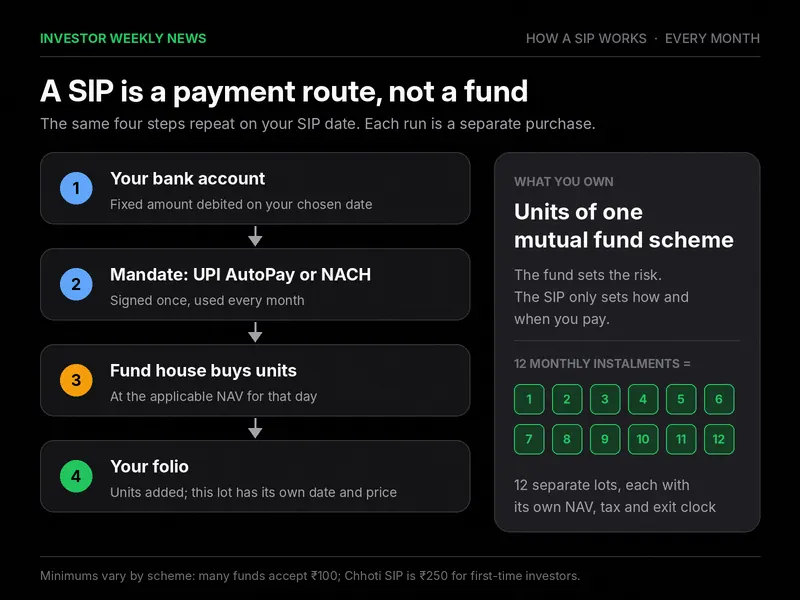
A SIP has four parts that repeat on your chosen date. Your bank pays through a mandate you signed once, either UPI AutoPay or a NACH e-mandate. The fund house receives the money and buys units of your chosen scheme at the applicable NAV. The units land in your folio, the account the fund house keeps for you. Nothing else is bought. There is no separate “SIP product” sitting between you and the fund.
That is why “which SIP is best?” is the wrong question. The useful questions are which fund suits your goal and time frame, and whether you will keep paying when that fund falls. A SIP in an overnight fund and a SIP in a small-cap fund use the same mechanism and carry completely different risks.
What happens to each instalment
Every instalment is its own purchase, with its own date, NAV and number of units. Twelve monthly instalments in a year give you twelve separate lots inside one folio. Most beginner guides skip this, but it decides three things later:
- Exit load. If the fund charges an exit load for early redemption, the clock runs separately for each instalment, as UTI Mutual Fund notes. Equity funds commonly charge around 1% on units redeemed within a set period, often one year; check the scheme’s Key Information Memorandum.
- Tax. Each instalment has its own holding period, and redemptions use first in, first out (FIFO), so one withdrawal can mix short-term and long-term gains, per Bajaj Finserv AMC.
- ELSS lock-in. In a tax-saving ELSS fund, every instalment is locked for three years from its own date. The instalment you pay in March 2027 is free only in March 2030.
Rupee cost averaging, with the maths done properly
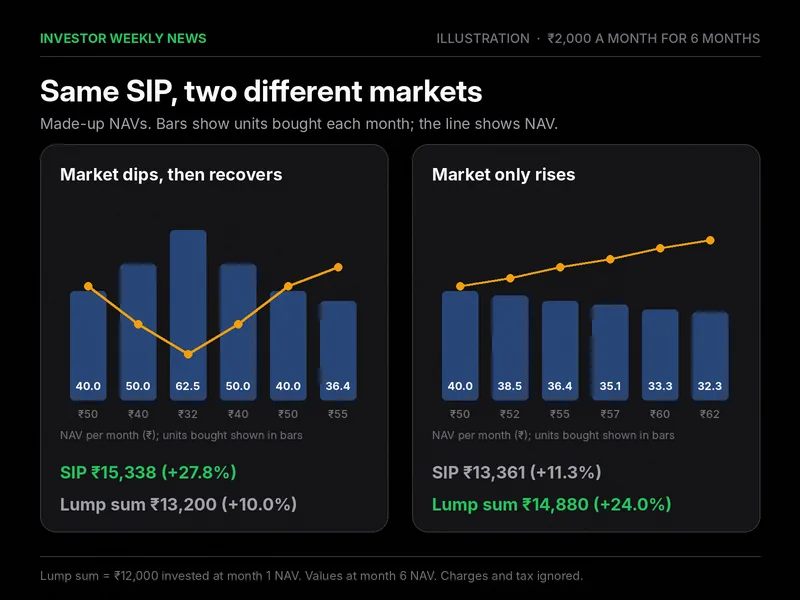
A fixed amount buys more units when the NAV is low and fewer when it is high. Your average cost per unit therefore ends up slightly below the average NAV. That part is maths, not marketing. What it does not promise is a higher return than investing all at once. The two illustrations below use made-up NAVs and ₹2,000 a month for six months.
| Month | NAV: market dips | Units bought | NAV: market only rises | Units bought |
|---|---|---|---|---|
| 1 | ₹50 | 40.00 | ₹50 | 40.00 |
| 2 | ₹40 | 50.00 | ₹52 | 38.46 |
| 3 | ₹32 | 62.50 | ₹55 | 36.36 |
| 4 | ₹40 | 50.00 | ₹57 | 35.09 |
| 5 | ₹50 | 40.00 | ₹60 | 33.33 |
| 6 | ₹55 | 36.36 | ₹62 | 32.26 |
| Total | Average NAV ₹44.50 | 278.86 | Average NAV ₹56.00 | 215.50 |
| Average cost per unit | ₹43.03 | ₹55.68 | ||
| Value of ₹12,000 SIP at month 6 | ₹15,338 (+27.8%) | ₹13,361 (+11.3%) | ||
| Value of ₹12,000 lump sum put in at month 1 | ₹13,200 (+10.0%) | ₹14,880 (+24.0%) |
Illustration only. Not the NAV of any real fund. Charges and taxes ignored.
When the market dipped and recovered, the SIP did far better because it bought cheap units in months two to four. When the market only rose, the lump sum won, because all the money was invested at the lowest price on day one. In both cases the SIP’s average cost sat below the average NAV. So the honest pitch for a SIP is narrower than most ads suggest: it removes the need to guess the right day, spreads your buying across good and bad months, and fits a monthly salary. It does not guarantee a better result.
One SIP, many tax clocks
In the growth option, mutual fund gains are taxed when you redeem, not while you hold. For the 2026-27 tax year, Budget 2026 left the rates unchanged, according to One Percent Club’s tax guide:
| Fund type | Held for | Tax on the gain |
|---|---|---|
| Equity funds, including ELSS and equity index funds | 12 months or less | 20% (short-term) |
| Equity funds | More than 12 months | 12.5% on long-term gains above ₹1.25 lakh in a year |
| Debt funds bought on or after 1 April 2023 | Any period | Your income-tax slab rate |
A 4% cess is added to the tax. Rules for other fund types, such as hybrids, depend on their equity share.
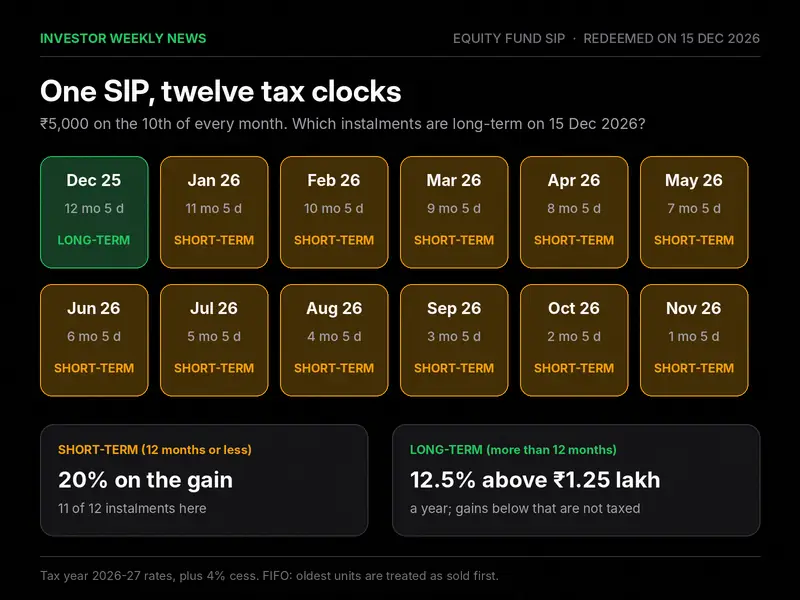
Here is where per-instalment holding periods bite. Say you start a ₹5,000 monthly SIP in an equity fund on 10 December 2025 and redeem everything on 15 December 2026. Only the first instalment has been held for more than 12 months. The other eleven, from January to November 2026, are short-term. If those eleven carry ₹5,000 of gains between them, the tax is ₹1,000 plus cess. Wait until each instalment is more than 12 months old and its gain becomes long-term instead, and long-term gains up to ₹1.25 lakh in a year are not taxed.
ELSS is the one SIP that can still cut your tax bill, and only if you file under the old regime. From 1 April 2026 the deduction sits in Section 123 of the Income-tax Act, 2025, replacing Section 80C, with the same ₹1.5 lakh limit, as Business Today explains. Under the new regime, which is the default, ELSS gives no deduction at all, per Value Research.
When an instalment fails, or you want to stop
| Situation | What happens |
|---|---|
| One instalment fails (low balance, mandate issue) | No penalty from the fund house, but your bank may charge a bounce fee. The fund house has to tell you the instalment failed. Earlier units stay invested |
| Three monthly instalments fail in a row | The SIP is cancelled automatically. For quarterly and other longer frequencies, two failures are enough |
| You ask the fund house to cancel | It must be processed within two working days |
| You want a break, not an exit | Many fund houses and platforms offer a pause for a set number of months; the SIP restarts on its own |
| You stop the SIP | Only future instalments stop. Your units stay invested until you redeem them |
Sources: Kotak Mutual Fund on missed instalments; INDmoney on AMFI’s failure thresholds; Angel One on SEBI’s two-day cancellation rule; Lokmat Times on SEBI’s notification rules; Policybazaar on pausing.
Two practical points. Set your SIP date three or four days after your salary usually arrives, so a late credit doesn’t bounce the debit. And if you cancel, check your bank or UPI app a few days later to confirm the mandate has gone; SEBI requires the fund house to stop the debit, but it costs you nothing to verify.
What changed for SIP investors in 2025 and 2026
- Chhoti SIP, ₹250. A small-ticket SIP for first-time mutual fund investors: ₹250 per instalment, up to three such SIPs (one each in up to three fund houses), monthly or fortnightly. It carries a minimum commitment of 60 instalments on paper, but no restriction on stopping or withdrawing early, per HDFC Mutual Fund. By June 2026 there were about 3.22 lakh Chhoti SIPs, per Business Standard.
- ₹100 minimums. Almost all of the 15 largest fund houses had cut their minimum SIP to as low as ₹100 by mid-2025, per Business Standard.
- Direct plans by default. Since 1 November 2026, fund house websites and apps show the direct plan first. Regular plans, which pay a distributor commission through a higher expense ratio, are still available, and existing SIPs are not converted, per 5paisa.
- New tax law. The Income-tax Act, 2025 took over from 1 April 2026. Capital gains rates did not change, but section numbers did, including 80C becoming Section 123.
The latest numbers show both sides of SIP investing. Investors put ₹32,160 crore into SIPs in October 2026, close to September’s record of ₹32,490 crore. In the same month 59.1 lakh SIPs were discontinued and only 50.7 lakh registered, per Mata Securities’ summary of AMFI data. Part of that count is SIPs that simply reached their end date, as The Hans India notes, but it came after a rough year: a Nifty 50 index fund lost 10.6% in the 12 months to 31 October 2026, while the same fund returned 11.1% a year over ten years, per Bandhan Mutual Fund’s factsheet data. SIPs work over long stretches. They feel worst in exactly the months that make them work. Our stock market section tracks the index moves behind these numbers.
How to start your first SIP: a six-step checklist
- Finish KYC once. You need PAN, Aadhaar and a bank account in your name, and it can be done online.
- Match the fund to the goal. Money needed within three years generally belongs in debt or liquid funds; equity funds suit goals five or more years away. A broad index fund is a simple first pick.
- Choose direct or regular. Direct plans cost less. Regular plans make sense only if you want, and actually use, a distributor’s help.
- Pick the amount and date. Start with an amount you can pay even in a bad month. Set the date a few days after payday.
- Set up the mandate. Approve UPI AutoPay or a NACH e-mandate. Keep the mandate limit a little above your SIP so a later step-up doesn’t need a new one.
- Review once a year, not once a day. Raise the amount when your income rises (a step-up SIP can do this automatically) and check the fund still fits your goal.
Use only SEBI-registered platforms and advisers, or AMFI-registered distributors. SEBI’s investor website has more free guides for first-time investors. Our mutual funds and ETFs section compares fund types in more depth.
FAQs
Can you lose money in a SIP?
Yes. A SIP is only a way of paying into a mutual fund, so it carries that fund’s risk. Equity funds can show a loss for a year or more: a lump sum in a Nifty 50 index fund lost about 10.6% in the 12 months to October 2026. Historically, losses have become less likely the longer people stayed invested, but they are never ruled out.
What is the minimum amount for a SIP?
Many funds accept ₹100 a month, and some go lower. First-time investors can also use Chhoti SIP at ₹250 an instalment. Check the scheme’s minimum before you register, because it varies by fund.
Can I withdraw my SIP money anytime?
Yes, except in ELSS, where each instalment is locked for three years. Redeeming early can attract an exit load on recent instalments and short-term capital gains tax.
Is a SIP better than a recurring deposit?
They do different jobs. A recurring deposit pays a fixed, known interest rate. A SIP in an equity fund has no fixed return and can fall in value, but has historically suited long-term goals better. For money needed within a year or two, a recurring deposit or a debt fund is usually the steadier choice.
Which SIP date should I choose?
No date reliably earns more than another, so choose one that suits your cash flow. Three or four days after your salary arrives works well, because the debit is unlikely to bounce.
Is SIP investment tax-free?
No. Gains are taxed when you redeem, at 20% for equity fund units held up to 12 months and 12.5% on long-term gains above ₹1.25 lakh a year, plus cess. Gains on debt funds bought since April 2023 are taxed at your slab rate. Only ELSS gives a deduction, and only under the old tax regime.
How we checked this
We read the current pages of the top-ranking SIP guides and checked every rule against fund house material, SEBI and AMFI data as reported by named outlets, and tax guides updated for the 2026-27 tax year. The rupee cost averaging tables and the tax example are our own illustrations with stated assumptions. This page will be updated when SEBI, AMFI or the Budget changes a rule mentioned here.
Building a monthly investing habit? Our personal finance guides cover budgeting, tax and saving. Subscribe free to get the week’s market and money news in one email.
This article is for information only and is not investment or tax advice. Mutual fund investments are subject to market risks; read all scheme-related documents carefully. Consider speaking to a SEBI-registered investment adviser.
Leave a Reply