

Quick Answer
SBI Long Term Equity Fund Regular Plan Growth is the regular, growth option of SBI Mutual Fund’s tax-saving ELSS scheme, which was renamed SBI ELSS Tax Saver Fund from 30 June 2025. It is an open-ended equity fund with a 3-year lock-in, benchmarked to the BSE 500 TRI, with assets of about Rs 30,027 crore (30 September 2026) and a regular-plan expense ratio of about 1.87%. Investments qualify for a deduction of up to Rs 1.5 lakh only under the old tax regime, now under Section 123 of the Income-tax Act, 2025. The direct plan of the same fund costs less each year.
If you searched for this fund by name and could not find it on your investment app, nothing is wrong with your app. The fund changed its name, and that is only the first thing worth knowing before you invest in it or keep investing in it.
This article treats the fund the way a careful investor would: checking what it is called, what it holds, what it costs in the regular plan, how the new Income-tax Act affects it, and what to look at before you start or continue a SIP. It does not tell you to buy or sell the fund.
The Name Puzzle: One Fund, Three Names
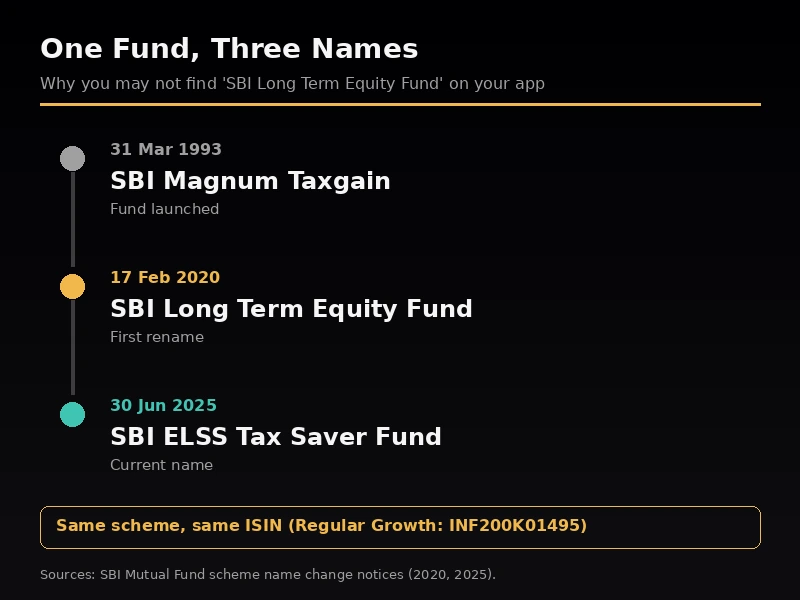
The scheme was launched on 31 March 1993 as SBI Magnum Taxgain. SBI Mutual Fund renamed it SBI Long Term Equity Fund from 17 February 2020, and then SBI ELSS Tax Saver Fund with effect from 30 June 2025, in the same round of changes that turned SBI Bluechip Fund into SBI Large Cap Fund.
What did not change is the scheme itself. The regular growth option keeps the same ISIN, INF200K01495, so if you already hold units bought under the old name, your folio, lock-in dates and holding period carry on as before. On most platforms you will now find it as “SBI ELSS Tax Saver Fund – Regular Plan – Growth”, often with “erstwhile SBI Long Term Equity Fund” in brackets.
Fund Snapshot
| Detail | SBI ELSS Tax Saver Fund – Regular Plan – Growth |
|---|---|
| Former name | SBI Long Term Equity Fund (before that, SBI Magnum Taxgain) |
| Category | Equity: ELSS (tax saving), open-ended |
| Launch date | 31 March 1993 |
| Benchmark | BSE 500 TRI |
| Fund managers | Dinesh Balachandran and Milind Agrawal |
| Assets under management | About Rs 30,027 crore (30 September 2026) |
| Expense ratio, regular plan | About 1.87% (29 September 2026) |
| Lock-in | 3 years from each investment |
| Minimum investment | Rs 500 (lump sum and SIP) |
| Riskometer | Very High |
Data as reported by fund research platforms (AdvisorKhoj/MutualFundsKaro, Dezerv, Business Today) for September to October 2026. Figures change monthly; check the latest factsheet on sbimf.com before investing.
What the Fund Holds
Business Today’s portfolio data as of July 2026 showed the direct plan, which holds the same portfolio as the regular plan, at about 95.7% in equity and 4.2% in cash, with a large-cap tilt: roughly 64% large caps, 16% mid caps and 16% small caps. Banks were the biggest industry exposure at about 26% of the portfolio.
In plain terms, this is a diversified equity fund with a strong lean towards large, established companies, especially banks. That matters because the fund’s ups and downs will tend to follow how Indian banks and large companies perform. If your other investments are also heavy in banking stocks or large-cap funds, adding this fund may add less diversification than you expect.
Performance in Context
| Period | Regular plan return (annualised) |
|---|---|
| 1 year | -3.94% |
| 3 years | 13.91% |
| 5 years | 13.29% |
| 10 years | 13.84% |
| Since inception (1993) | About 11.8% CAGR |
Returns as reported on MutualFundsKaro around 30 September 2026. Past performance may or may not be sustained in future and is not a guarantee of future returns.
Two things stand out. First, the recent one-year return was negative while the longer periods were in the low-teens, which is typical of equity funds: short periods can disappoint even when long periods look healthy. Second, these numbers are for the regular plan; the direct plan of the same fund typically shows higher returns because of its lower costs, which brings us to the most practical point in this article.
The Regular Plan Question: What You Pay for Convenience
A regular plan is sold through a distributor, and part of its expense ratio pays that distributor’s commission. A direct plan of the same fund is bought straight from the fund house or a direct platform, with no commission, so its expense ratio is lower. Platform data for 2026 has shown the regular plan at roughly 1.8% to 1.9% and the direct plan at roughly 1.0% to 1.25%.
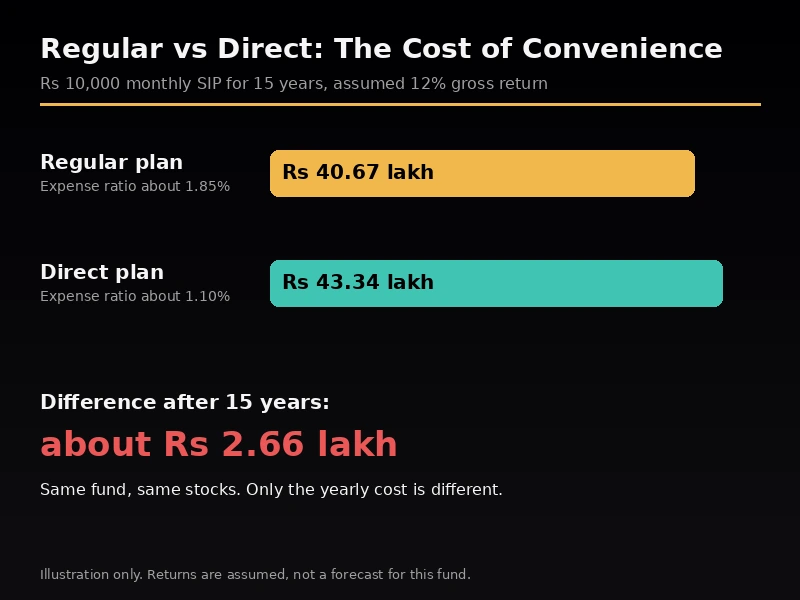
Example: take a Rs 10,000 monthly SIP for 15 years and assume the fund earns 12% a year before costs. With a 1.85% yearly expense ratio, the corpus would be about Rs 40.67 lakh; with 1.10%, about Rs 43.34 lakh. The gap of about Rs 2.66 lakh comes entirely from costs, on Rs 18 lakh invested. These returns are an assumption for illustration, not a forecast for this fund.
That does not mean the regular plan is wrong for everyone. If a distributor genuinely helps you choose funds, stay invested during falls and handle paperwork, that service has value. The question to ask is whether the help you receive is worth what you pay for it every year.
Thinking of moving from regular to direct? Switching between plans is treated as a redemption followed by a fresh purchase. In an ELSS, you can only switch units whose 3-year lock-in has ended, the switch may trigger capital gains tax, and the new direct-plan units start a fresh 3-year lock-in. Many investors simply start new SIPs in the direct plan and leave existing locked units to complete their lock-in.
Tax Rules in 2026: What Changed and What Did Not
The deduction now sits under Section 123
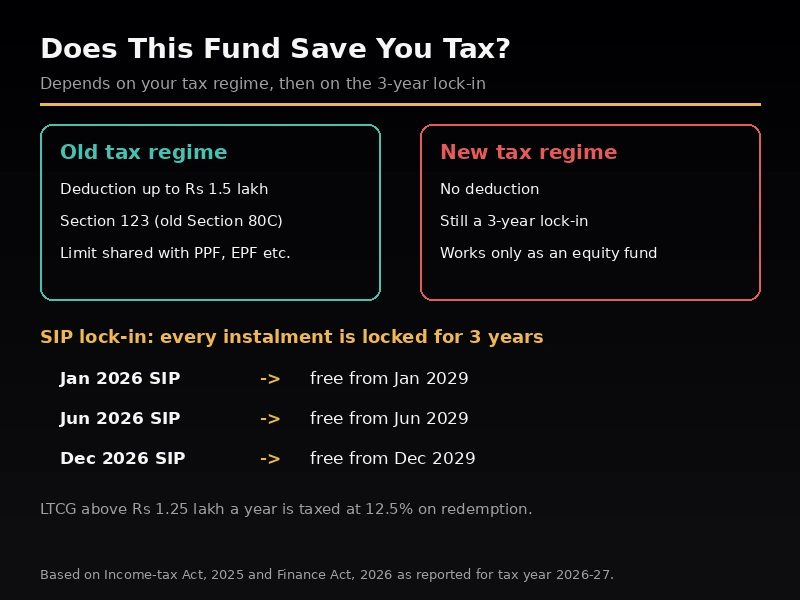
From tax year 2026-27, the Income-tax Act, 2025 replaced the 1961 Act. The familiar Section 80C deduction of up to Rs 1.5 lakh now lives in Section 123, read with Schedule XV. The substance is the same, but the deduction is available only under the old tax regime. Under the new regime, which is the default, you can still invest in this fund but you get no deduction.
The Rs 1.5 lakh limit is shared
ELSS shares the Rs 1.5 lakh limit with EPF, PPF, life insurance premiums, home loan principal and other eligible items. A salaried person whose own EPF contribution is Rs 3,000 a month already uses Rs 36,000 of the limit, leaving Rs 1.14 lakh. Our employees provident fund guide explains how those contributions are calculated.
Tax when you redeem
Since ELSS units are locked for 3 years, gains are always long-term when you sell. Long-term capital gains on equity funds above Rs 1.25 lakh in a tax year are taxed at 12.5%, without indexation. These rates were not changed by Budget 2026.
How the lock-in works for a SIP
Each SIP instalment is locked for 3 years from its own date. A SIP started in January 2026 does not become fully free in January 2029; only the January 2026 instalment does. The December 2026 instalment stays locked until December 2029.
Who This Fund May and May Not Suit
| It may suit you if | Think twice if |
|---|---|
| You use the old tax regime and still have room in the Rs 1.5 lakh limit | You are on the new tax regime and want a tax deduction |
| You can leave the money untouched for at least 3 years, ideally longer | You may need the money within 3 years |
| You accept very high risk and short-term losses | A fall like the recent negative 1-year return would make you sell |
| You value a distributor’s ongoing help (regular plan) | You are comfortable investing on your own (the direct plan costs less) |
If you are unsure whether equity funds fit your goals at all, our comparison of FD vs gold vs mutual funds lays out how each option behaves.
Before You Start or Continue a SIP: A Checklist
- Confirm your tax regime for this year. If it is the new regime, the tax benefit does not apply.
- Check how much of the Rs 1.5 lakh limit your EPF, PPF and insurance already use.
- Decide between regular and direct plan based on whether you need a distributor’s help.
- Read the latest factsheet on sbimf.com for current holdings, expense ratio and returns against the benchmark.
- Note that each instalment has its own 3-year lock-in before planning any withdrawal.
Frequently Asked Questions
Is SBI Long Term Equity Fund the same as SBI ELSS Tax Saver Fund?
Yes. SBI Mutual Fund renamed SBI Long Term Equity Fund as SBI ELSS Tax Saver Fund with effect from 30 June 2025. It is the same scheme, and the regular growth option keeps ISIN INF200K01495.
What is the lock-in period of SBI Long Term Equity Fund?
Three years from the date of each investment. For a SIP, every monthly instalment has its own 3-year lock-in.
What is the expense ratio of the regular plan?
Fund platforms reported the regular plan’s expense ratio at about 1.87% as of 29 September 2026. The direct plan of the same fund has a lower expense ratio. Check sbimf.com for the current figure, as it can change.
Can I claim a tax deduction on this fund under the new tax regime?
No. The deduction of up to Rs 1.5 lakh, now under Section 123 of the Income-tax Act, 2025, is available only if you choose the old tax regime.
How are gains from this fund taxed?
Because of the 3-year lock-in, gains are long-term. Long-term capital gains from equity funds above Rs 1.25 lakh in a tax year are taxed at 12.5% without indexation.
Should I switch from the regular plan to the direct plan?
It depends on whether you value your distributor’s service. A switch is treated as a redemption, is allowed only for units past their 3-year lock-in, may trigger capital gains tax, and starts a fresh lock-in for the new units. Many investors start new SIPs in the direct plan instead.
Your Next Step
Open your latest consolidated account statement or investment app and check two things: whether your holding shows “Regular” or “Direct”, and which tax regime you chose this year. Those two answers tell you more about whether this fund is working for you than any return table.
Disclaimer
Mutual fund investments are subject to market risks; read all scheme-related documents carefully. This article is for general information and education only and is not investment, tax or financial advice, nor a recommendation to buy, sell or hold any scheme. Fund data is taken from third-party research platforms as of the dates stated and may differ from the latest official factsheet. Return illustrations use assumed rates and do not predict this fund’s performance. Past performance may or may not be sustained in future. Please consult a SEBI-registered investment adviser and a tax professional before making investment decisions.
About the Author
Sonja has 10 years of experience and writes on business and personal finance basics for Indian readers at Pro Business Cop. She explains fund costs, tax rules and product changes in plain language, without recommending specific investments.
Leave a Reply