

Quick Answer
Axis Midcap Fund Regular Growth returned 14.99% a year over 3 years and 10.65% over 5 years as of 18 Nov 2026, against 13.45% and 13.15% for its benchmark, the BSE 150 Midcap TRI. Its total expense ratio was 1.79% (AMFI data, 30 Oct 2026), roughly 1 percentage point more than the Direct plan, which holds the same portfolio. It suits investors who want a distributor’s help and can stay invested for 7 years or more.
Picture two cousins who put money into the same mid-cap fund on the same morning. Same stocks, same fund managers, same NAV movements. Five years later, one has ₹931 more for every ₹10,000 invested. The only thing that separates them is one word on the account statement: Regular.
That word is what this article is about. We look at how the Axis Midcap Fund Regular Growth option has really performed, what the regular plan costs you in rupees, what sits inside the portfolio today, and the exit load and tax rules that changed recently. All figures are dated, because fund data goes stale fast and several popular pages still show old tax rates.
The Fund at a Glance
| Detail | What it is | As of |
| Category | Mid cap equity, open-ended | Scheme page |
| Launch date | 18 Feb 2011 | Allotment date |
| NAV (Regular Growth) | ₹123.45 | 20 Nov 2026 |
| Fund size (AUM) | ₹33,309.32 crore | 31 Oct 2026 |
| Total expense ratio, Regular | 1.79% | 30 Oct 2026 (AMFI) |
| Benchmark | BSE 150 Midcap TRI | Scheme page |
| Riskometer | Very High | Scheme page |
| Exit load | 1% on units beyond 10% if redeemed within 3 months; nil after | Scheme page |
| Fund managers | Shreyash Devalkar, Nitin Arora, Krishnaa N | Scheme page |
Sources: Axis Mutual Fund scheme page and AMFI data as reported by Advisorkhoj. Expense ratios change; check the current figure on the Axis website before you invest.
How the Regular Plan Has Actually Performed
Here are the official numbers from Axis Mutual Fund, calculated on the Regular Growth NAV as of 18 November 2026. The last column shows what ₹10,000 invested at the start of each period became.
| Period | Regular Growth (CAGR) | BSE 150 Midcap TRI | ₹10,000 became |
| 1 year | 1.03% | -4.76% | ₹10,103 |
| 3 years | 14.99% | 13.45% | ₹15,206 |
| 5 years | 10.65% | 13.15% | ₹16,597 |
| Since launch (Feb 2011) | 16.88% | 15.65% | ₹1,15,930 |

Three things stand out. First, over the past year the fund stayed slightly positive while its benchmark fell nearly 5%. That kind of downside protection is what many investors want from an active mid-cap fund.
Second, the 5-year number is the weak spot. The regular plan trailed its benchmark by 2.5 percentage points a year over that stretch. On ₹10,000, that is ₹16,597 against ₹18,557 for the index. A low-cost index fund tracking this benchmark would likely have done better for someone who invested in late 2021.
Third, over the full 15-year history the fund is ahead of the index. So the record is mixed by period, not one-sided. Your experience depends heavily on when you entered.
The Price of Convenience: Regular vs Direct in Rupees
Every mutual fund scheme has two plans. The Direct plan is bought straight from the fund house or a direct platform. The Regular plan is bought through a distributor, such as a bank relationship manager or a mutual fund agent, and part of its expense ratio pays that distributor’s commission.
The portfolio is identical. Only the cost differs. The Regular plan’s TER was 1.79% against about 0.8% for Direct as of late October 2026, so the gap is close to 1 percentage point a year. We found a similar cost gap in our review of SBI Long Term Equity Fund Regular Plan Growth, so this is a pattern across fund houses, not an Axis quirk. You can see it in the 1-year returns: 1.03% for Regular and 2.03% for Direct, on the same date.
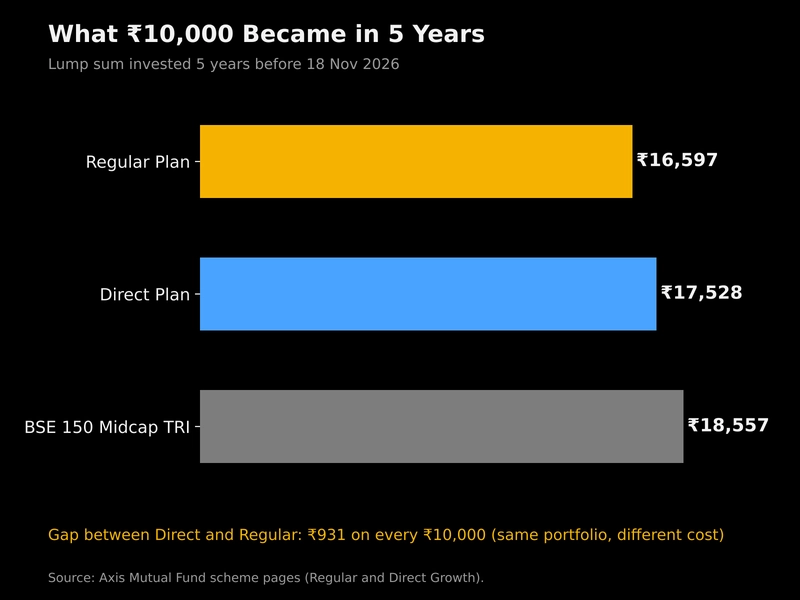
A worked example: Suppose Meera invested a ₹5 lakh lump sum five years ago. Using the official 5-year figures, the Regular plan would now be worth about ₹8,29,850. The Direct plan would be worth about ₹8,76,400. That is a difference of roughly ₹46,550, paid out over five years for the distributor’s service. Over 15 or 20 years, the gap compounds further.
When Paying for the Regular Plan Can Make Sense
A higher cost is not automatically a bad deal. It can be worth paying if your distributor actually does work for you:
- They stop you from selling in panic when mid caps fall 20% or more, which has happened several times in this category.
- They handle paperwork, nominations, KYC updates and portfolio reviews that you would otherwise skip.
- You are new to investing and would not invest at all without someone guiding you.
If your distributor only processed the form once and has not called since, you are paying for a service you are not using. That is the honest test.
What the Portfolio Holds Right Now
As of 31 October 2026, about 92.35% of the fund was in equities. The scheme must keep at least 65% in mid-cap companies, which SEBI defines as the 101st to 250th largest listed companies by full market capitalisation. The fund was comfortably above that floor.
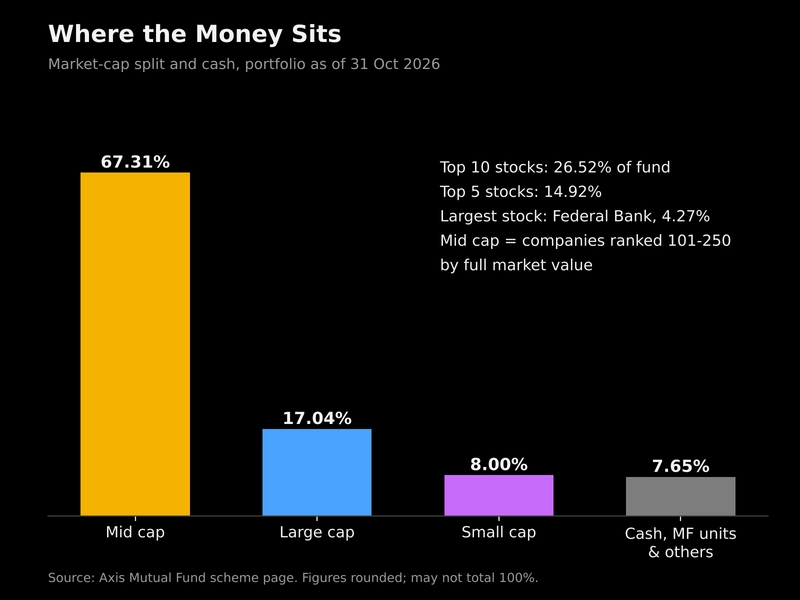
Top holdings included The Federal Bank (4.27%), Sona BLW Precision Forgings (2.91%), The Indian Hotels Company (2.67%), Fortis Healthcare (2.62%) and Apar Industries (2.45%). The top 10 stocks together made up 26.52% of the fund, so no single company dominates.
By sector, the largest weights were financial services (18.62%), capital goods (12.97%), automobiles and auto components (12.85%), consumer services (12.27%) and healthcare (11.88%).
One detail worth noticing: roughly 6.71% sat in net current assets, which is largely cash and cash-like holdings. A cash buffer can soften falls, which may partly explain the better 1-year number. It can also hold back returns when markets rally hard.
Risk: How Bumpy Has the Ride Been?
Mid-cap funds swing more than large-cap funds, and this one carries a Very High riskometer label. The fund’s own 3-year statistics, to 30 October 2026, give a clearer picture:
- Standard deviation: 16.52%. This measures how widely returns moved. Dezerv’s category data puts the mid-cap average at 18.46%, so this fund has been a little calmer than its peers.
- Beta: 0.85. The fund has moved somewhat less than its benchmark on average.
- Sharpe ratio: 0.56. This shows return earned per unit of risk, calculated with a 5.74% risk-free rate.
Lower volatility than the category is useful, but it is not a promise. A 30% fall in mid caps would still hit this fund hard.
Exit Load and Tax After 1 April 2026
Two rule sets matter when you sell: the fund’s exit load and the government’s capital gains tax.
Exit load: The current Axis scheme page says that if you redeem or switch out within 3 months, the first 10% of units is free and the rest attracts a 1% load. After 3 months, there is no exit load. An older Key Information Memorandum from November 2025 showed a 12-month period, so confirm the current wording on the scheme page or in the latest SID before relying on it.
Example: you invest ₹1,00,000 and redeem everything in the second month when it is worth ₹1,04,000. The first 10% (₹10,400) is free. A 1% load applies on the remaining ₹93,600, so you pay about ₹936.
Tax: The Income-tax Act, 2025 replaced the 1961 Act from 1 April 2026, but the rates for equity-oriented funds did not change, according to Taxmann. Units held for 12 months or less are short-term and taxed at 20%. Units held longer are long-term, and gains above ₹1.25 lakh in a tax year are taxed at 12.5%. Surcharge and cess apply on top. Directly held shares follow the same equity rates, as explained in our beginner’s guide to investing in the share market.
Example: if your total long-term gains from all equity funds and shares in a tax year are ₹2,00,000, the first ₹1,25,000 is tax-free and you pay 12.5% on ₹75,000, which is ₹9,375 plus cess. Note that the ₹1.25 lakh limit covers all your equity gains together, not each fund separately.
Switching From Regular to Direct Is a Sale
Many investors plan to move to the Direct plan after reading comparisons like the one above. Keep in mind that a switch between plans is treated as a redemption followed by a fresh purchase. It can trigger capital gains tax, and an exit load if done within the load period. If you have large unrealised gains, a staggered switch that uses the ₹1.25 lakh yearly exemption may cost less in tax. A tax professional can help you plan this.
A 5-Point Check Before You Invest
- Time horizon: Can you leave this money alone for at least 7 years? Mid caps can stay below their peak for long stretches. If the goal is retirement, our retirement calculator guide helps you work out the monthly amount you need.
- Plan choice: Decide consciously between Regular and Direct. If you pick Regular, know what service you are paying for.
- Overlap: If you already own a large-and-midcap or flexi-cap fund, check how many stocks repeat.
- Fit in your portfolio: Many investors keep mid caps as one part of their equity allocation rather than the core. Your share depends on your goals and risk appetite.
- Dated data: Check the NAV, TER and exit load on the Axis Mutual Fund website or AMFI on the day you invest.
Our Take: The Bull and Bear Case
The bull case: a long track record since 2011, a stable lead manager since November 2016, lower volatility than the category, and good protection in the most recent year when its benchmark fell.
The bear case: the 5-year record trails the index by a wide margin, the regular plan costs about 1 percentage point a year more than Direct, and a large cash holding can drag on returns in strong rallies.
For a long-term investor who values hand-holding, the Regular Growth option is a reasonable vehicle with a clear, measurable cost. For a confident do-it-yourself investor, the same fund is available more cheaply through the Direct plan. Neither choice removes the high risk that comes with mid-cap equity.
Frequently Asked Questions
What is the NAV of Axis Midcap Fund Regular Growth?
The NAV was ₹123.45 on 20 November 2026. NAV is published every business day, so check AMFI or the Axis website for today’s figure.
Is the Regular plan worse than the Direct plan?
It holds exactly the same stocks, so the fund management is the same. The Regular plan simply costs more each year because it includes distributor commission. Whether that is worse depends on whether you use the distributor’s guidance.
Who manages Axis Midcap Fund?
Shreyash Devalkar has managed it since 23 November 2016. Nitin Arora joined on 3 August 2023 and Krishnaa N on 1 March 2024.
Can I lose money in this fund?
Yes. It is rated Very High risk, and mid-cap stocks can fall sharply in a correction. There is no guaranteed return, and past performance may not repeat.
What is the minimum amount to start?
AMFI-listed scheme data shows a minimum investment of ₹100. SIP minimums can vary by platform, so confirm on the app or with your distributor. New to SIPs? Our explainer on how a SIP really works covers the basics.
How long should I stay invested?
Mid-cap funds generally suit goals that are at least 7 years away. Over shorter periods, the result depends heavily on your entry point. Even this fund’s 5-year record, measured from late 2021, lagged its index by a wide margin.
What to Do Next
Pull out your latest mutual fund statement and look for the word Regular or Direct next to each scheme. If you hold Regular plans, ask yourself what your distributor did for you this year. Then explore more fund explainers in our Mutual Funds and ETFs section.
Disclaimer
This article is for educational purposes only and is not investment, tax or legal advice. Mutual fund investments are subject to market risks; read all scheme-related documents carefully. Past performance may or may not be sustained in future. Figures are as of the dates mentioned and may have changed. Please consult a SEBI-registered investment adviser or a qualified tax professional before making decisions.
About the Author
Sonja Dewing
M.Com | 10 years of experience
Sonja Dewing writes on mutual funds and personal finance for Investor Weekly News.
Leave a Reply